
Drainage & Site Work
Drainage, French Drains, and Grading Correction
Water is the reason most hardscape fails early, and almost none of the damage happens where the water lands. It happens where the water collects, where it soaks in, and where it moves under the surface — which is why a drainage problem shows up as a sunken patio, a cracked driveway, or a wall leaning out of line.
3-year workmanship warranty
In writing, on every job we install.
- 3 years Drainage and French drain installations
What we install
Most properties do not need one component, they need a route: somewhere for the water to be collected, a path for it to travel, and somewhere legal and lower for it to end. These are the pieces we build that route out of.
French drains
Perforated pipe in washed stone, wrapped in filter fabric, laid to a consistent fall. Intercepts water moving through the ground and carries it away from foundations, patios, and low areas.
Trench and channel drains
A surface grate that catches runoff before it reaches a garage, a walkout basement, or a low point in a driveway. The standard answer for a drive that slopes toward the house.
Downspout drainage
Roof water piped underground and discharged well clear of the building. A single downspout can deliver thousands of gallons a year to one spot beside your foundation.
Catch basins and dry wells
Collection points for a low area, and buffered storage where there is no fall to a daylight outfall.
Grading and regrading
Re-establishing positive fall away from the house. Where it works, it is the cheapest fix available and it needs no pipe at all.
Swales and surface routing
A shaped, planted channel that carries surface water across a property. Quieter than a pipe and it never silts up.
Drainage and your driveway
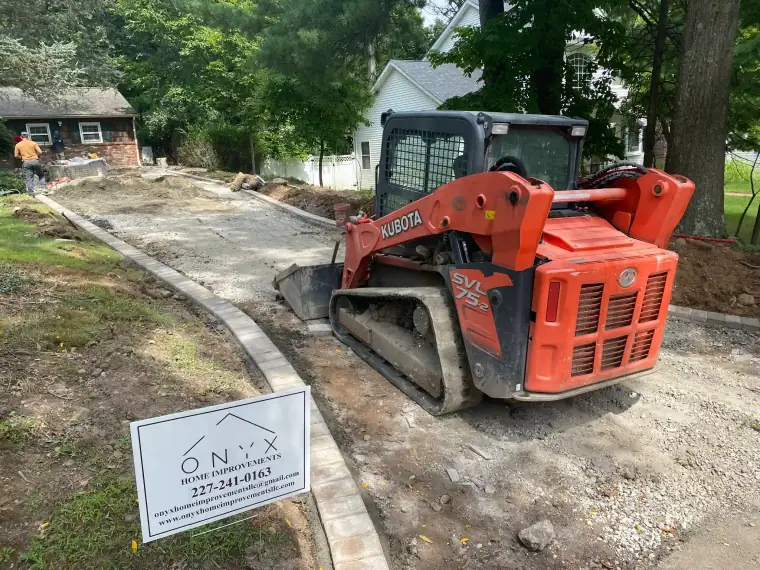
A driveway is a large impermeable surface, usually sloped, often pointing at a garage or a house. Whatever falls on it has to go somewhere, and if the grading was set carelessly, that somewhere is your garage slab or the base under the paving.
Water travelling under a driveway washes fine material out of the aggregate base. The base loses its support, the surface settles into it, and you get the depression, the alligator cracking, or the sunken paver field that prompted the call. Repaving without fixing the source produces the same failure in the same place on the same schedule.
On any driveway job we look at where water arrives and where it currently leaves, and price the correction openly. Sometimes that is a change of pitch during construction and costs almost nothing. Sometimes it is a trench drain across the apron tied into a piped run to daylight.
Drainage and your patio
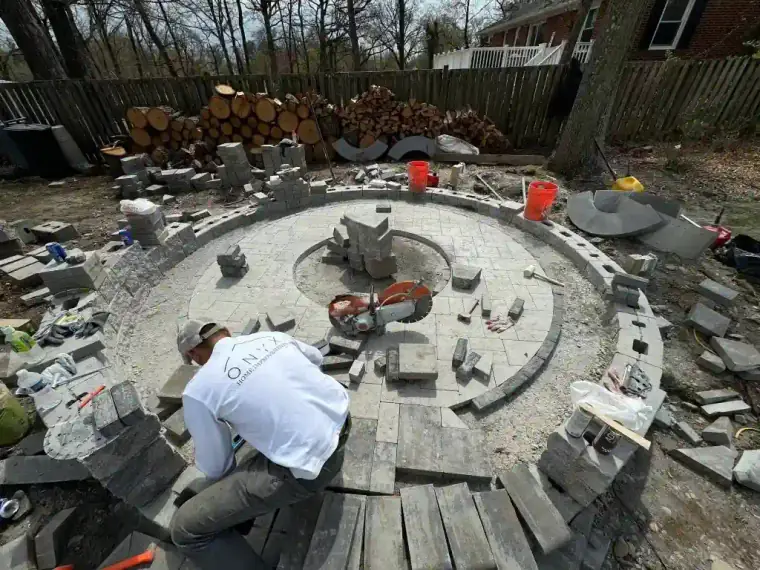
A patio that pools after rain has either lost its fall or never had it. On a paver patio the field can be lifted, the base corrected and recompacted, the grade re-established, and the same units reset — you generally do not need new material. On a poured slab the options are narrower, which is one of the arguments for pavers.
The other patio drainage problem is what happens at the edges. A patio that sits below the surrounding grade collects everything the lawn sheds, and the fix is interception — a French drain along the uphill side, or a channel drain across the point where water arrives — rather than anything done to the patio itself.
Drainage and retaining walls
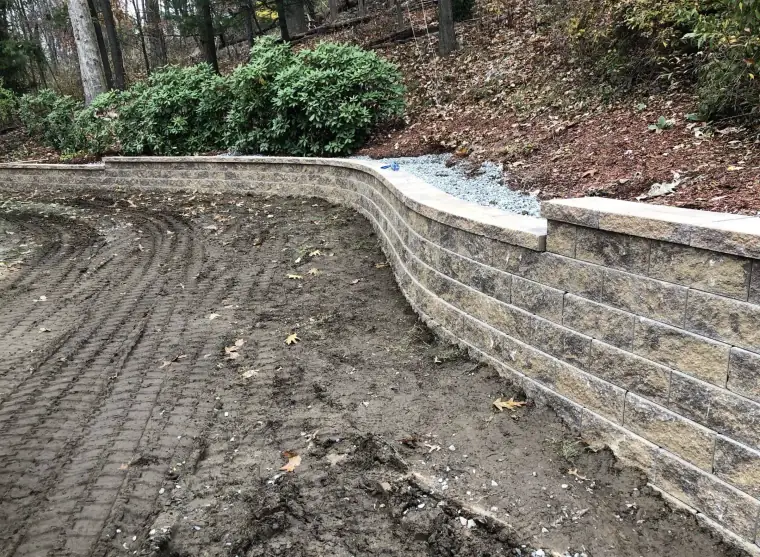
A retaining wall holds back soil, and saturated soil weighs dramatically more than dry soil and pushes considerably harder. Hydrostatic pressure behind a wall is the single most common reason walls lean, bulge, and eventually come down, and it is entirely preventable.
Every wall we build gets drainage aggregate behind it, filter fabric to keep the soil out of that aggregate, and a drain at the base running to an outfall. Weep holes through the face where the construction suits them. None of it is visible in the finished wall, which is exactly why it is the part that gets left out by whoever built the wall you are now asking us to look at.
Water against the house
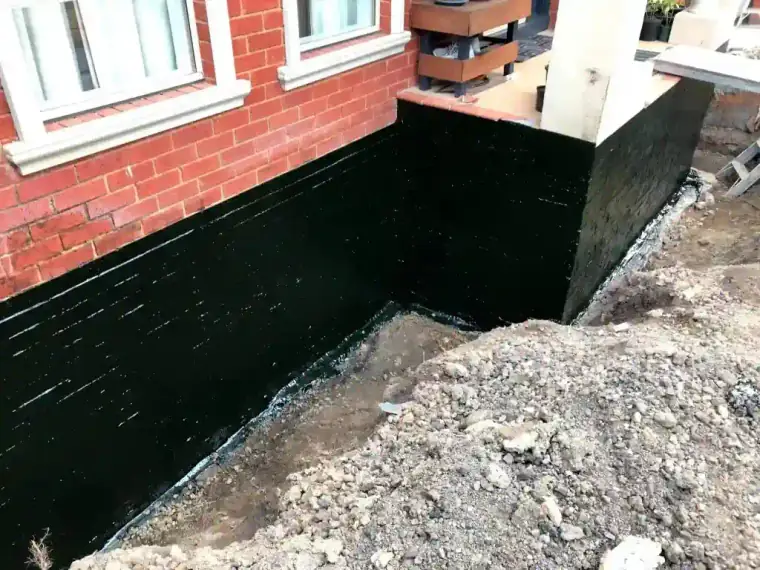
A damp basement wall, efflorescence on the block, or a persistent wet patch beside the foundation is a drainage symptom before it is a waterproofing problem. The usual causes are grade that has settled back toward the house over the years, downspouts discharging at the wall, and a patio or walk that was built pitching the wrong way.
We start with the cheap answers, because they are often the right ones: extend the downspouts properly underground, re-establish positive grade for the first several feet out from the wall, and correct any hard surface that is delivering water to the foundation. Where that is genuinely not enough, a French drain along the affected side is the next step.
Why we raise it whether or not you asked
Most people call us about a surface — a driveway, a patio, a wall. A good proportion of those surfaces failed because of water, and rebuilding them without dealing with it means selling you the same job twice.
So we look at drainage on every estimate, we tell you what we find, and we price it as a separate line so you can see exactly what it costs and choose. Sometimes the honest answer is that your drainage is fine and nothing needs doing. We would rather say that than add a French drain to a quote to make the number look thorough.
How the work runs
Drainage & Water Management, step by step
Every job follows the same sequence. You are told which stage you are at and what happens next.
Find out where the water actually comes from
Before anything is priced we work out where the water arrives, how much of it there is, and where it is currently going. Roof area, driveway area, neighbouring grade, and downspout discharge all feed the same problem, and fixing one of four sources fixes nothing.
Establish where it can go
Water has to end up somewhere legal and lower than where it started. We identify the outfall first — daylight at a slope, a dry well, or a street connection — because a drain with nowhere to discharge is a buried pipe full of standing water.
Written scope and estimate
You get the route, the components, and the price in writing, with the drainage broken out as its own line rather than buried in a paving total.
Excavation to grade
Trenches are dug to a consistent fall along the whole run. Fall is the entire mechanism — a pipe laid flat, or laid with a dip in the middle, collects sediment and stops working within a couple of seasons.
Pipe, stone, and fabric
Perforated pipe bedded in washed stone and wrapped in filter fabric for a French drain; solid pipe for a downspout or trench-drain carry. Fabric goes around the stone, not around the pipe alone, or the stone silts up and the drain dies.
Inlets, outlets, and cleanouts
Catch basins, channel drains, pop-up emitters, and cleanout access at the points where the system will one day need rodding. A drain you cannot clean is a drain with an expiry date.
Backfill, restore, and test
Backfilled and compacted, surfaces made good, and the system run with a hose so you can see water arrive at the outfall before we leave.
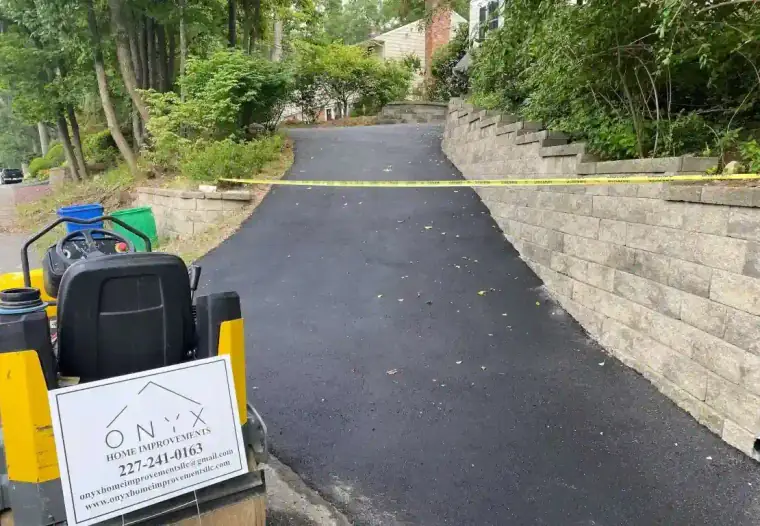
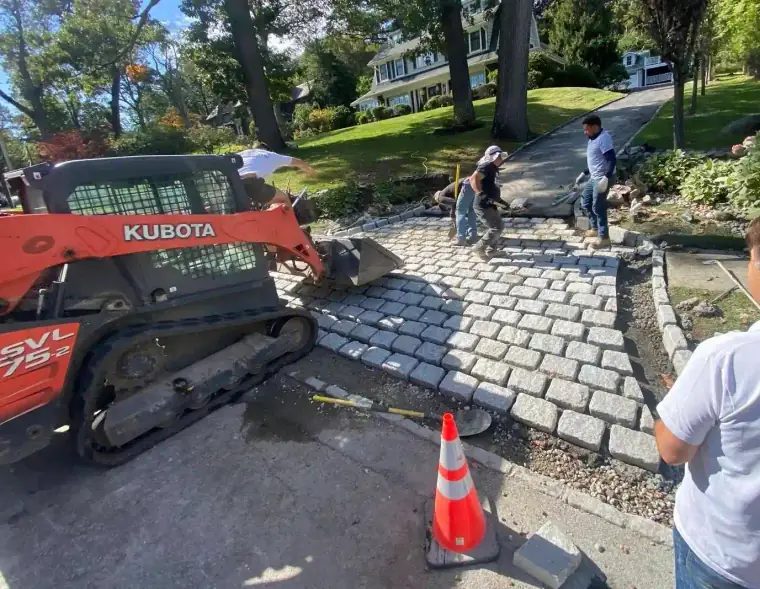
Drainage & Water Management photographs
★★★★★
John and his team replaced our back brick stairs that were falling apart. They were able to create a new set of stairs that matched our old pavers much better than the previous stairs. They were able to re-grade/level our patio so that it now sits flat. The grading before prevented us from being able to sit our table flat without wobbling. Lastly they provided a new walkway into our backyard. We love the new look and functionality.
Questions
Frequently asked
What is a French drain, and do I need one?
A French drain is a perforated pipe laid in a stone-filled trench, wrapped in filter fabric, running downhill to somewhere the water can leave. It intercepts water moving through the ground and gives it a faster route than the one it was taking — which is usually through your foundation wall or under your patio.
You need one when water is arriving faster than the ground can absorb it and grading alone cannot redirect it: a yard that stays soggy for days, water against a basement wall, or a slope that sheets runoff toward the house.
What is the difference between a French drain and a trench drain?
A French drain is buried and collects water from the soil around it. A trench drain — also called a channel drain — sits at the surface with a grate along its length, and catches water running across a hard surface before it reaches somewhere you do not want it.
A driveway that slopes toward a garage almost always wants a trench drain across the apron. A yard that will not dry out wants a French drain. Plenty of properties want both, connected to the same outfall.
Where does the water actually go?
To daylight wherever the site allows it — a point lower than the collection area where the pipe can discharge onto the ground or into a swale. Where there is no fall to work with, the alternatives are a dry well that buffers the volume and lets it soak away, or, in some jurisdictions, a connection to the storm system.
We establish the outfall before we design the rest. A drainage system is only as good as the place it ends, and this is the question the cheap installations skip.
Can you fix drainage without digging up my whole yard?
Often, yes. The trench for a French drain is narrow, and turf goes back over it. Sometimes the answer is not a drain at all — regrading a low spot, extending downspout discharge well away from the house, or correcting the pitch on an existing patio can solve the problem outright and cost a fraction of a piped system.
We would rather sell you the regrade if the regrade is what works.
Why does my driveway or patio keep failing in the same spot?
Because the water that caused it is still arriving. Water under a paved surface washes fines out of the base, the base loses its support, and the surface settles or cracks in exactly the place it did before. Replacing the surface without addressing the source resets the clock and nothing else.
This is why we raise drainage on paving jobs whether or not it was in the enquiry. It goes in the estimate as a visible line item so you can see what it costs and decide with the number in front of you.
Will a drainage system need maintenance?
Very little, but not none. Catch basins and channel grates collect leaves and want clearing a couple of times a year, particularly in autumn. Pop-up emitters occasionally need the grass cut back from them. A properly built French drain — washed stone, fabric around the stone, consistent fall — should run for decades without attention, which is precisely why those three details are not the place to save money.
Also from Onyx
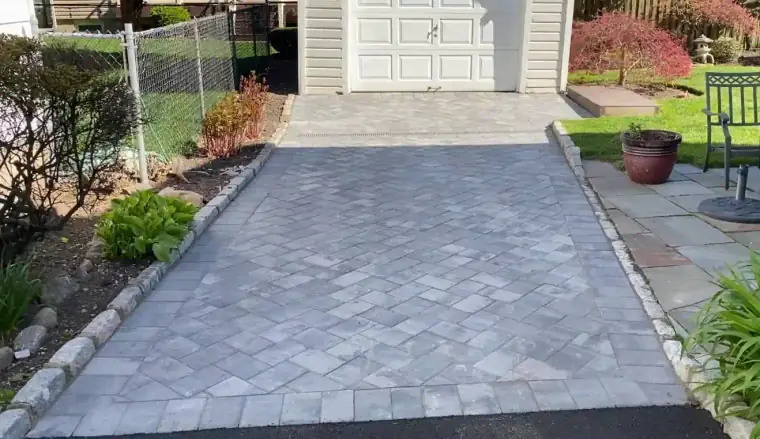
Driveway Paving
Asphalt, concrete, and paver driveways across Northern Virginia and DC. Base prep done right, every layer laid the way it should be.
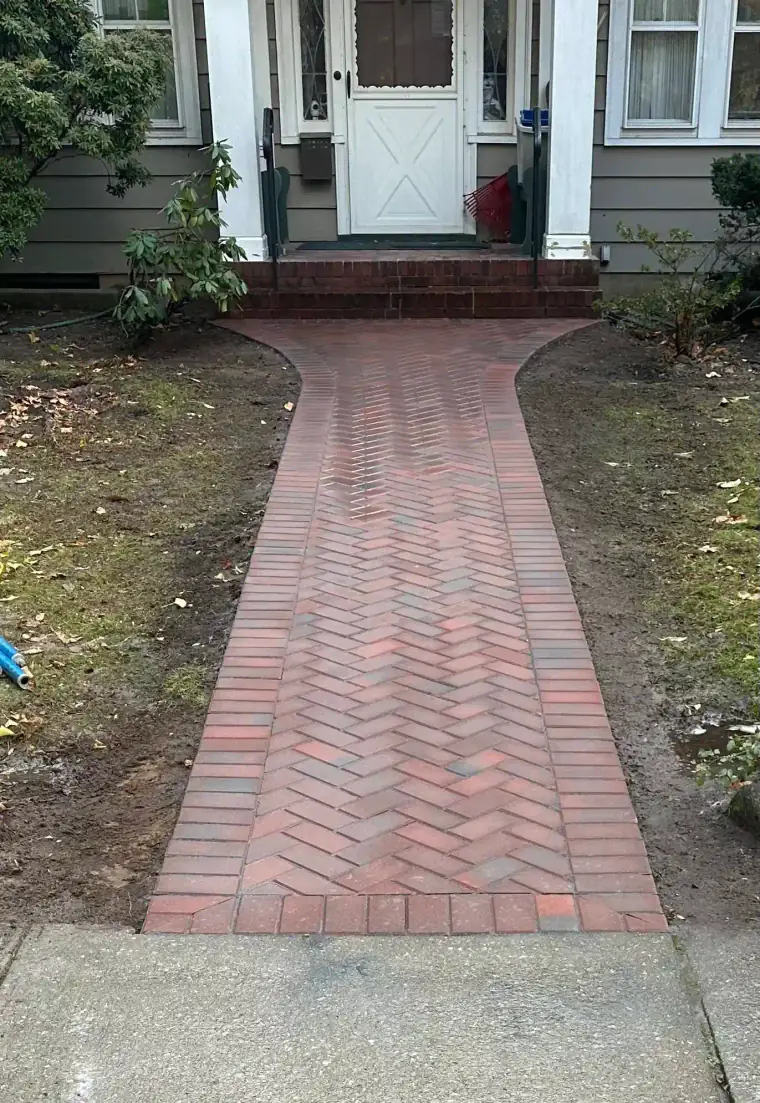
Brickwork
Brick patios, entryways, steps, facades, and repointing. Traditional technique, materials chosen to match what is already there.

Retaining Walls
Natural stone and segmental block walls that hold back soil, stop erosion, and add real structure to a yard.
Service area
Estimates are free everywhere on this list. If you are just outside it, call and ask — we often can.