
- Home
- Services
- Patio Installation & Design
- Stamped Concrete Patios
Stone Work
Stamped Concrete Patio Installation
Stamped concrete gives you the look of cut stone or brick across one continuous surface — no joints for weeds, no individual units to settle. It is a slab, so what it asks for is a proper base, honest jointing, and a finisher who knows how short the stamping window is.
5-year workmanship warranty
In writing, on every job we install.
- 5 years Concrete driveways, patios, and walkways
Also under Patio Installation & Design: Patio Installation & Design overview
Patterns that hold up at walking distance
The patterns that work are the ones with scale and irregularity. Large-format ashlar and random slate read convincingly because the joint lines are varied and the texture is deep. Small repeating patterns are the ones that give the game away, because the eye finds the repeat.
Ashlar slate
Large rectangular units in a coursed layout. The most versatile pattern and the one that suits the widest range of houses.
Random stone
Irregular shapes with no repeat visible at walking distance. The closest stamped concrete gets to laid flagstone.
Running bond brick
A brick field, usually run as a border or an apron rather than across a whole patio, and the obvious choice beside brick.
Seamless texture
Stone texture with no joint lines at all. Quiet, modern, and it makes a small patio feel larger than a patterned one does.
Colour is two decisions, not one
A stamped slab gets its colour from a base — integral colour through the mix, or a colour hardener worked into the surface — and then from a release agent applied before stamping, which settles into the low points of the texture and gives the surface depth and variation.
One colour alone reads flat and obviously manufactured. The secondary tone in the joints and hollows is what makes it read as stone. We pick the pair against the house and against the light the patio actually gets, because a colour chosen in shade behaves differently in full sun.
Borders, bands, and where it meets other surfaces
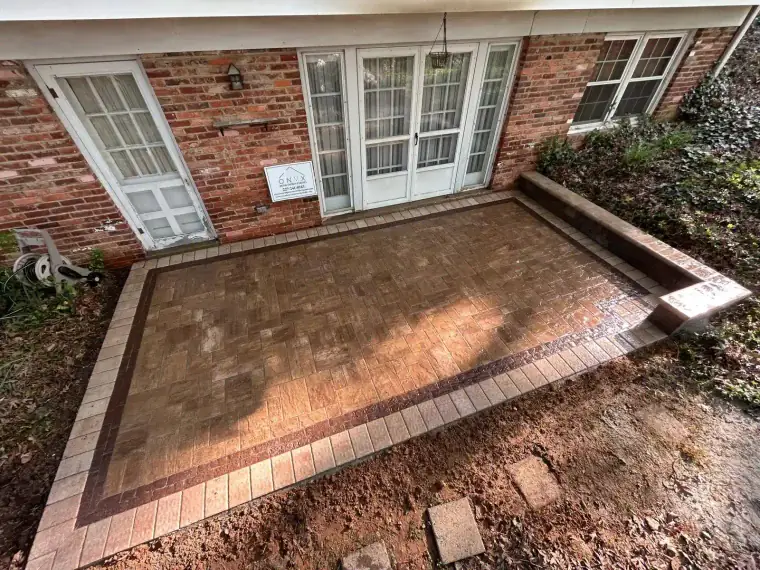
A stamped field is at its best framed. A contrasting border in a different pattern — a brick running bond around a slate field, or a plain band around a random stone — gives the patio an edge and stops the texture running raw into the lawn.
The transitions matter too. Where the patio meets a paver walkway, a set of steps, or an existing porch, the levels have to be set flush and the pitch has to carry water across the junction rather than into it. Those junctions are where a stamped patio either looks built or looks poured.
Sealing, and what it is actually doing
The sealer on a stamped patio is not optional in the way it is on a plain slab. It is holding the colour, keeping water out of the surface ahead of the freeze-thaw cycle, and giving the finish its depth. A patio that has gone pale and chalky is almost always overdue rather than damaged.
We seal once the slab has cured, with a grit additive in the mix for traction, and we tell you the reseal interval for your specific patio. Two to three years is typical here; a shaded patio under trees will want it sooner.
How the work runs
Stamped Concrete Patios, step by step
Every job follows the same sequence. You are told which stage you are at and what happens next.
Pattern and colour selection
Pattern, base colour, and release colour are chosen together, because they only make sense together. We show you the combination rather than the swatch — a colour on a sample chip and the same colour across four hundred square feet are different experiences.
Excavation and base
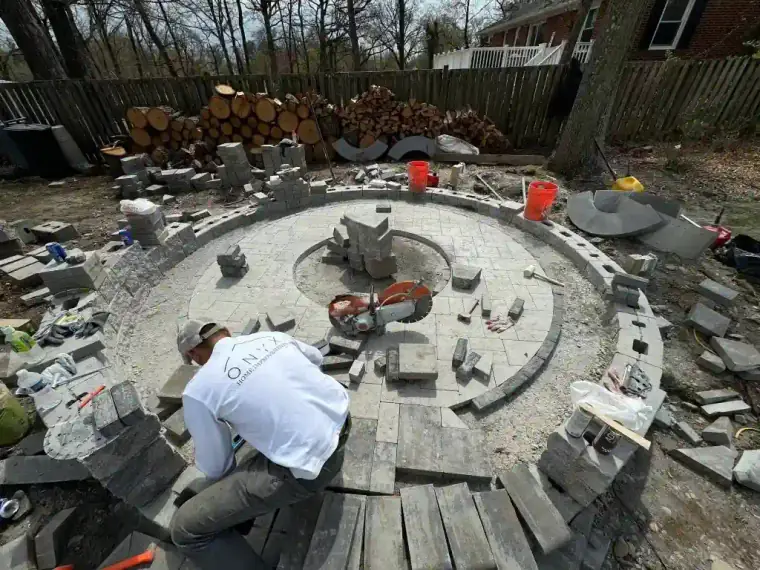
Dug out to depth and a compacted aggregate base laid in lifts. Stamped concrete is a slab like any other: it is rigid, and it needs a base that will not settle unevenly beneath it.
Forming and grading
Forms set to the finished line, with the fall established so water sheds off the patio and away from the house.
Reinforcement
Steel on chairs inside the slab. Fibre mesh in the mix where it suits the pour. Reinforcement lying on the subgrade is not reinforcement.
Pour and colouring
Placed and screeded, then integrally coloured or colour-hardened across the surface, depending on the finish agreed.
Stamping
Mats are worked into the surface within the window while the concrete is still plastic. This is the part that cannot be redone — the timing decides whether the texture is crisp or soft, and it is measured in minutes.
Jointing, curing, and sealing
Control joints cut into the pattern so they read as part of it, the slab cured properly, and a sealer applied once it has. The sealer is what holds the colour.
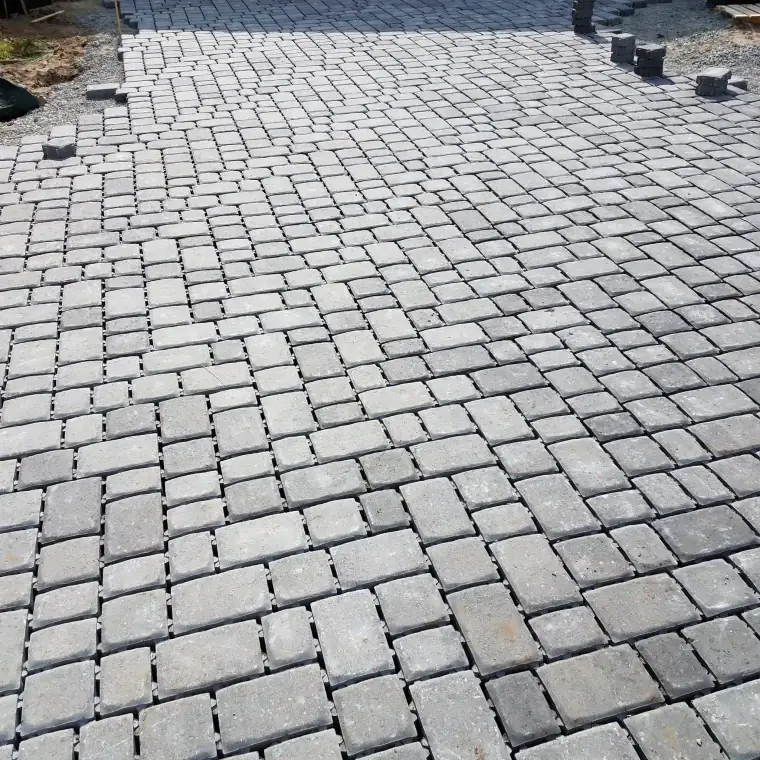
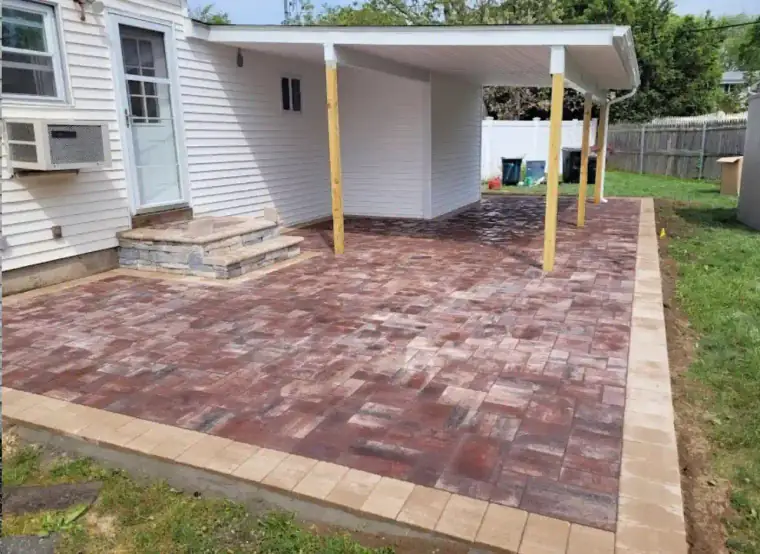
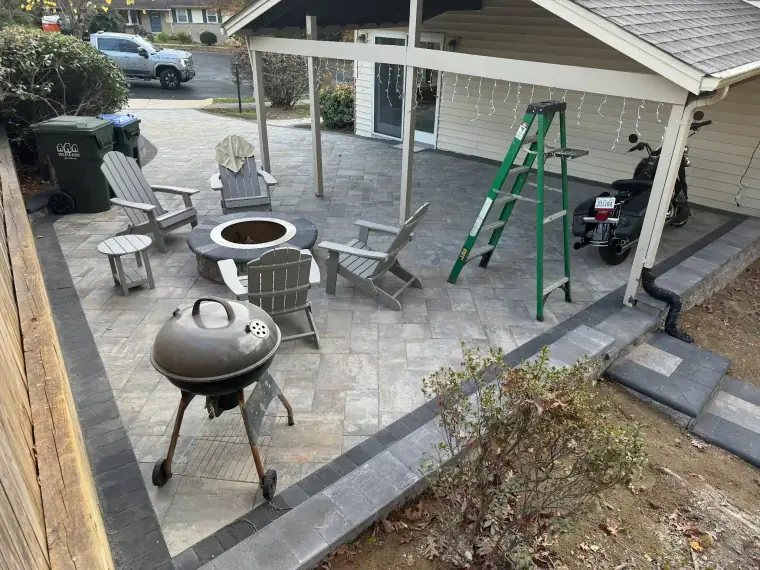
Stamped Concrete Patios photographs
★★★★★
Onyx’s response was fast and professional. They came out and gave a very fair price and did a fantastic job. They were professional, expedient, friendly and punctual. Would highly recommend them.
Questions
Frequently asked
How does stamped concrete compare with pavers?
Stamped concrete gives you a continuous surface with no joints for weeds and no individual units to settle, generally at a lower installed cost than natural stone and comparable to good pavers. It reads as slate, ashlar, or brick from a normal viewing distance.
Pavers win on repairability. A stained or cracked paver lifts out; a crack in a stamped slab is permanent, and a repair will be visible because matching colour and texture on an existing slab is very difficult. Choose stamped concrete for the surface and the price, pavers for the ability to undo things.
Will a stamped concrete patio crack?
It can, and control joints are how we decide where. Cut into the stamped pattern at the right spacing and depth, joints give the shrinkage somewhere to go and disappear into the texture. Random cracking across the field means the base, the steel, the joint spacing, or the mix was wrong.
Is stamped concrete slippery when wet?
The texture itself provides grip; the sealer is what can make it slick. We add a fine grit additive to the sealer as standard on walking surfaces, which restores traction without changing the appearance. It matters most around a pool or on any part of the patio that connects to steps.
How often does it need resealing?
Every two to three years in this climate, depending on sun exposure and how much of the surface stays wet. The sealer carries the colour depth and protects against freeze-thaw and staining, so a patio that has gone chalky and pale has usually just gone too long between coats rather than failed.
Can you stamp over an existing concrete patio?
Not stamp, no — the concrete has to be plastic to take a mat. There are stamped overlay systems that go over sound existing slabs, and they can look good, but they are a coating and they will only ever be as sound as the slab underneath. If the existing patio is cracked or moving, an overlay hides that for a season or two. We would rather tell you that up front.
Also from Onyx
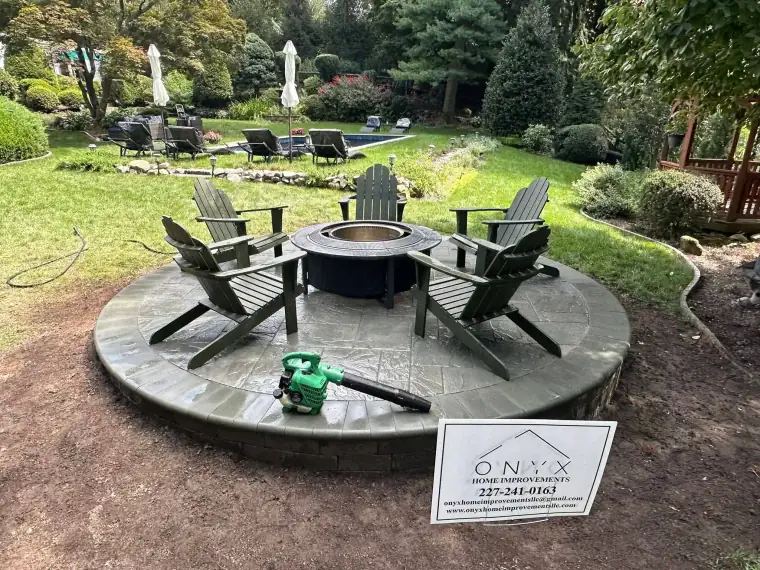
Patio Installation & Design
Paver, natural stone, brick, and stamped concrete patios built from the base up — designed around how you actually use the space.
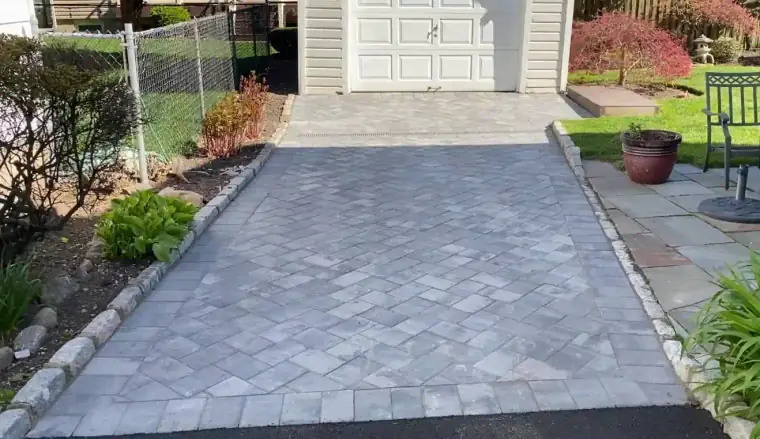
Driveway Paving
Asphalt, concrete, and paver driveways across Northern Virginia and DC. Base prep done right, every layer laid the way it should be.
Brickwork
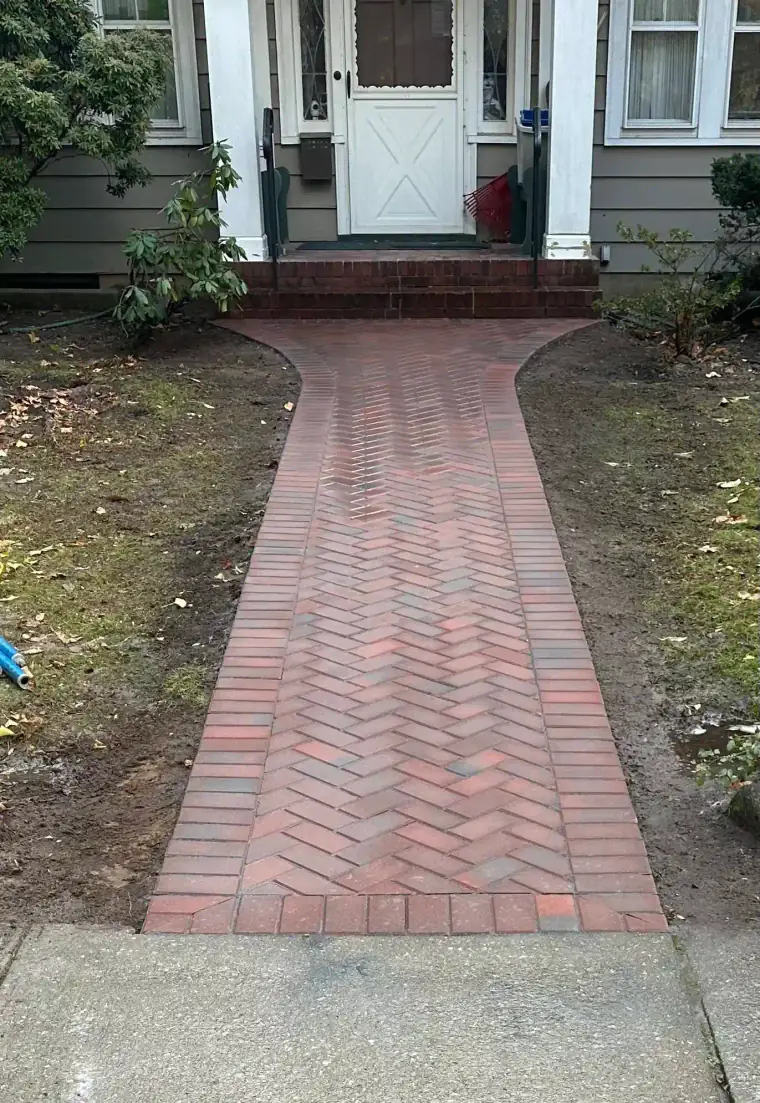
Brick patios, entryways, steps, facades, and repointing. Traditional technique, materials chosen to match what is already there.
Service area
Estimates are free everywhere on this list. If you are just outside it, call and ask — we often can.