
- Home
- Services
- Driveway Paving
- Concrete Driveways
Masonry
Concrete Driveway Installation
A poured concrete driveway is the cleanest uniform surface you can put in front of a house, and the one that asks least of you once it is in. It is also unforgiving of shortcuts: the base, the steel, and the joints all have to be right, because none of them can be corrected afterwards.
5-year workmanship warranty
In writing, on every job we install.
- 5 years Concrete driveways, patios, and walkways
Also under Driveway Paving: Asphalt DrivewaysPaver DrivewaysDriveway Paving overview
Finishes worth knowing about
Concrete is not one look. The finish is chosen on pour day and it cannot be changed later, so it is worth deciding deliberately rather than defaulting to whatever is quickest.
Broom finish
The standard, and the most practical. A light drag across the fresh surface gives the traction that keeps a driveway safe in a wet Northern Virginia winter.
Exposed aggregate
The top paste is washed back to reveal the stone in the mix. Textured, hard-wearing, and it hides surface staining far better than a smooth slab.
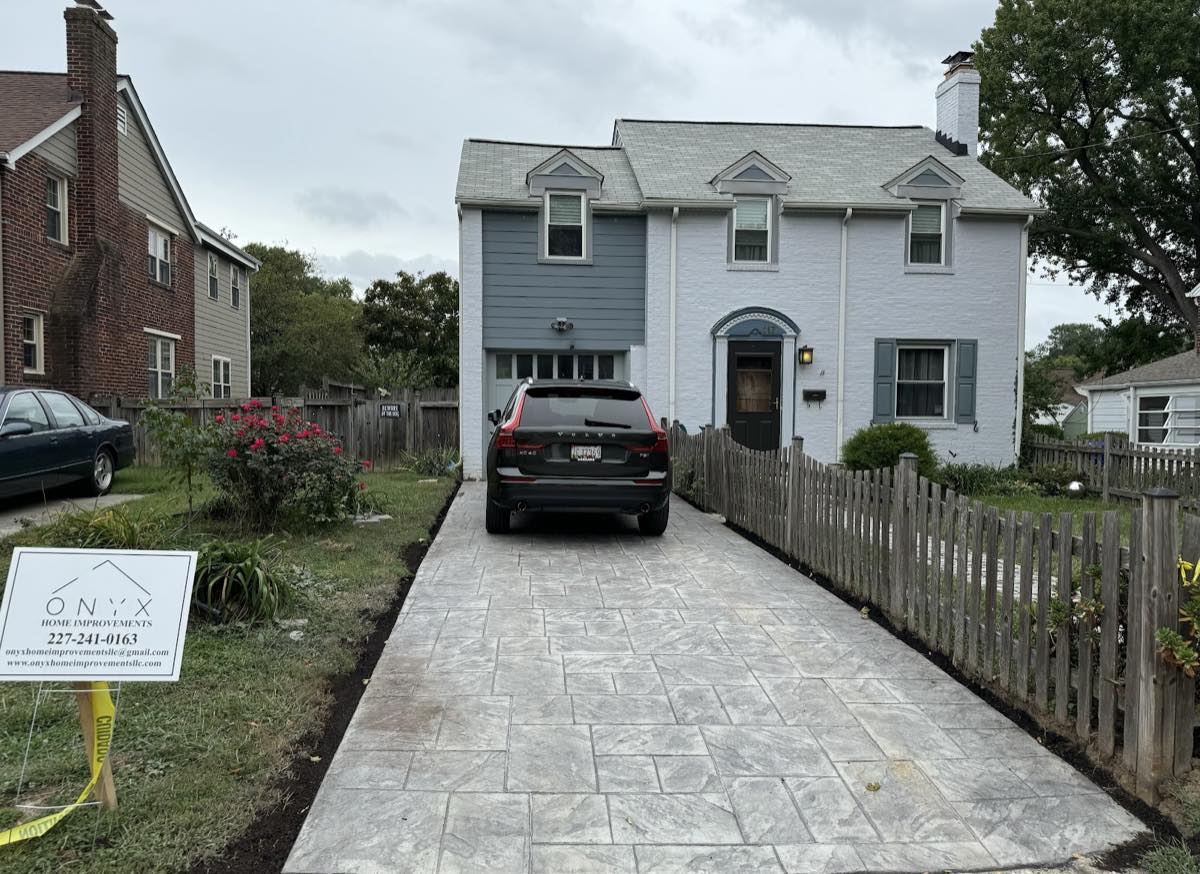
Stamped concrete
Textured while plastic to read as slate, ashlar, or brick, and integrally coloured. A continuous surface with no joints for weeds, at a fraction of the cost of the material it imitates.
Concrete with a paver border
A soldier course of pavers down each edge. It terminates the slab cleanly against the lawn and defines a curve that a raw concrete edge would make look accidental.
The three things that decide whether it lasts
Base, steel, and joints. A compacted aggregate base spreads the load and gives the slab something that will not settle under it. Reinforcement sits on chairs inside the slab, not underneath it, so it is actually holding the concrete together across a crack rather than resting uselessly on the subgrade.
Control joints are cut at spacing appropriate to the slab thickness and to a depth of about a quarter of it. Get that wrong and the slab cracks wherever it likes. Get it right and you never see a crack, because every one of them is hiding in a joint.
Freeze-thaw, salt, and what to expect here
Northern Virginia gives concrete a hard time: repeated freeze-thaw cycling all winter, and de-icing salt on top of it. Water that gets into the surface expands as it freezes and lifts the paste away in flakes — spalling — and salt accelerates the process considerably.
The defences are an air-entrained mix, a properly finished surface that is not overworked into a weak skin, drainage that does not leave water standing on the slab, and a penetrating sealer applied after the cure. We specify all of that as standard rather than as an upgrade.
Replacing a failed concrete driveway
Concrete that has cracked across the field, tipped at the joints, or spalled through to the aggregate has generally reached the end of what repair can do for it. Resurfacing a moving slab puts a new coating on the same problem.
We break it out, address whatever caused the failure — nearly always base or water — and pour a new slab that is jointed and reinforced properly. If the honest answer is that a section can be cut out and replaced rather than the whole drive, we will tell you that instead.
How the work runs
Concrete Driveways, step by step
Every job follows the same sequence. You are told which stage you are at and what happens next.
Site visit and written estimate
We measure, check access for the truck, and agree the finish — broom, exposed aggregate, or stamped — before anything is priced. Finish affects cost, so it belongs in the estimate rather than in a conversation on pour day.
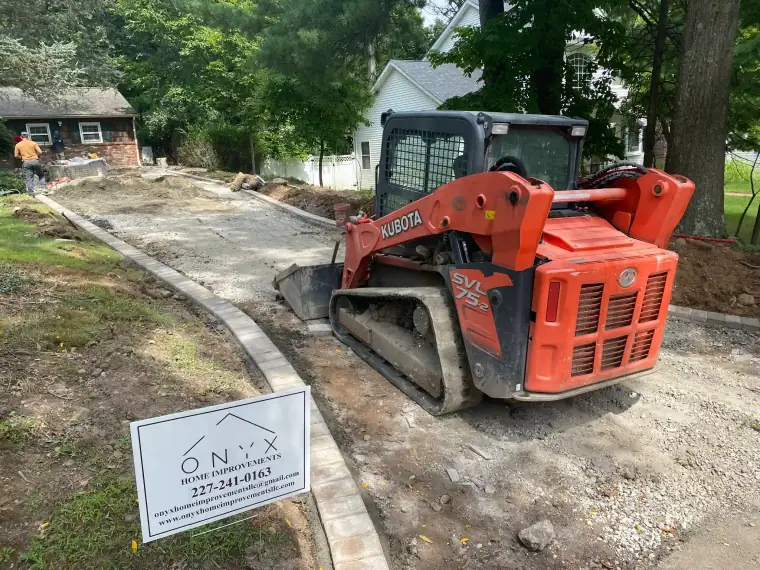
Demolition and excavation
The old surface is broken out and hauled away, and the subgrade is cut to the depth the new slab and its base need.
Base and compaction
Compacted aggregate under the slab, in lifts. Concrete is rigid: it does not tolerate a base that settles unevenly, and the result of one is a crack you cannot lift out and reset.
Forming and grading
Forms are set to the finished line and the fall is established so water leaves the slab and travels away from the house and garage.
Reinforcement
Rebar or mesh goes in on chairs so it sits within the slab rather than on the ground under it. Steel lying on the subgrade is doing nothing.
Pour, screed, and finish
Placed, screeded, floated, and finished to the agreed texture. Timing here is everything — a slab finished too early traps bleed water and a slab finished too late is fighting the set.
Jointing and curing
Control joints are cut at the right spacing and depth so the slab cracks where we decided rather than where it chooses, and the surface is kept damp or covered while it cures.
Recent work
Concrete Driveways projects
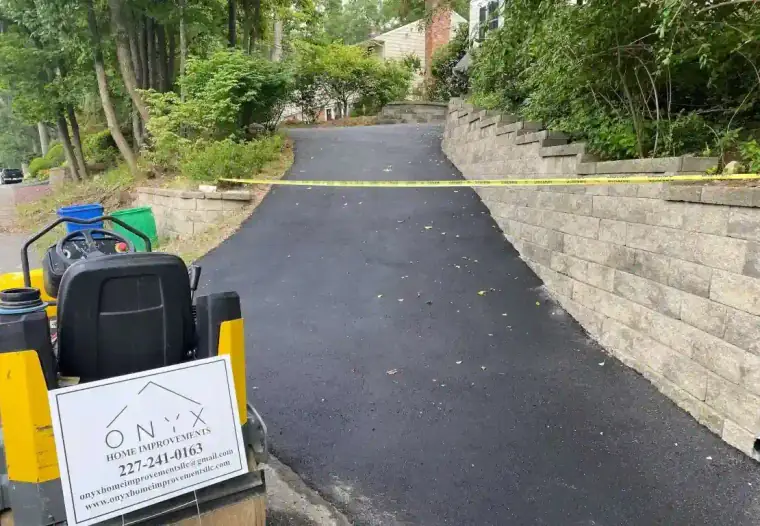
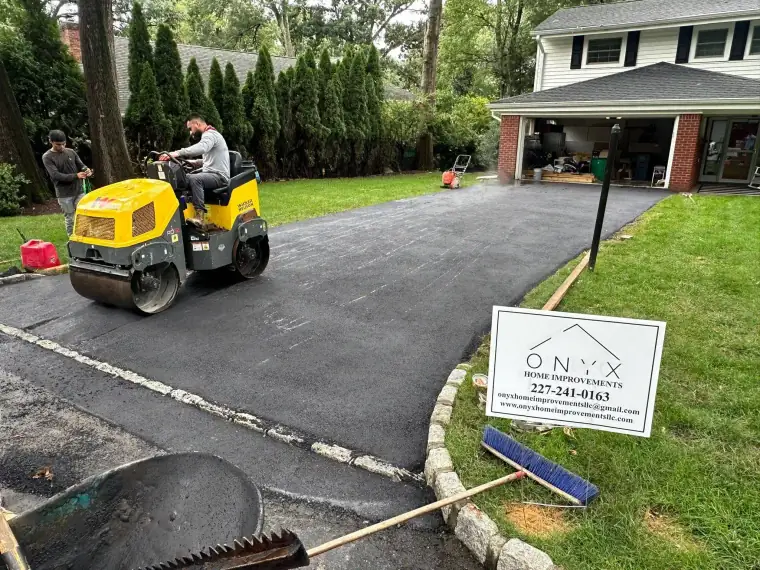
Recent concrete driveways jobs, each with its own page. Photographs are our own work.
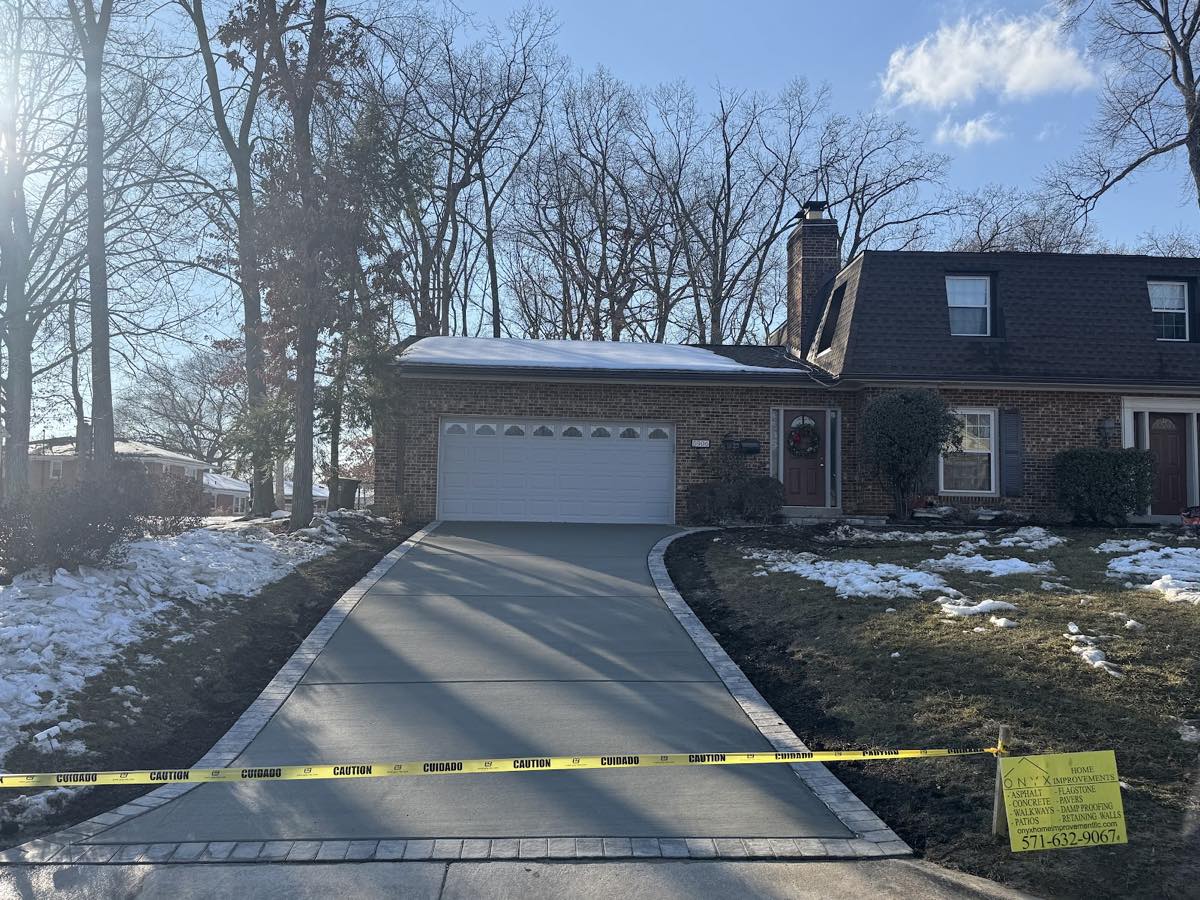
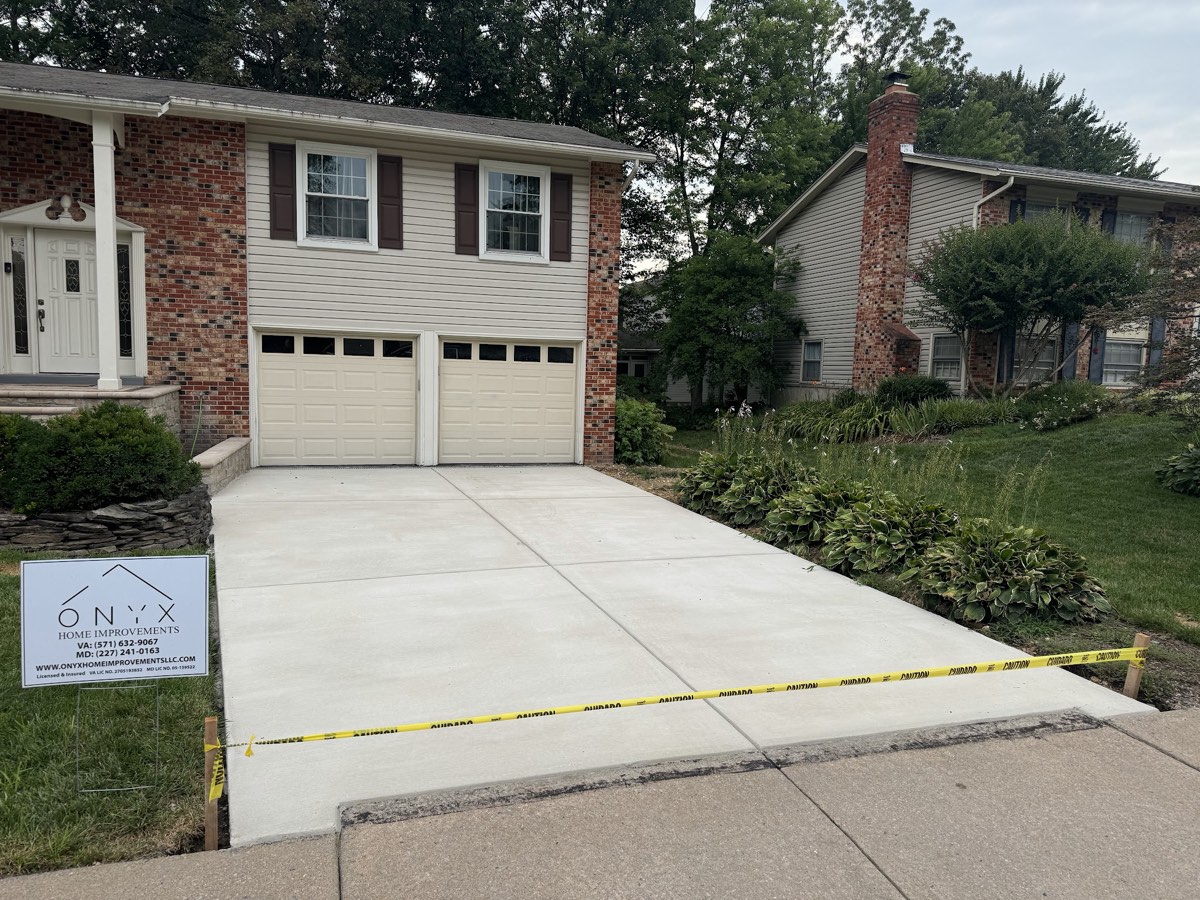
Concrete Driveways photographs
★★★★★
Had a great experience with Onyx replacing and widening our driveway. They also replaced our front entry steps. John Cash walked us through the process and then kept us informed of the next steps as the actual work was progressing. The crew was very professional and we are very happy with the finished product. Will definitely use again for any future projects.
Questions
Frequently asked
How long before I can drive on a new concrete driveway?
Foot traffic after 24 to 48 hours. Vehicles after seven days as a rule, and we ask you to keep anything heavier than a car — a loaded truck, a dumpster, a delivery lorry — off it for a full 28 days, which is when concrete reaches its design strength. We give you exact dates when the pour is done.
Will my concrete driveway crack?
Concrete shrinks as it cures, and shrinkage has to go somewhere. The job of a control joint is to decide where. Cut at the right spacing and to a quarter of the slab depth, joints give the slab a weak line to crack along, and the crack happens inside the joint where you never see it.
What is not normal is random cracking across the field, and that comes from an inadequate base, missing or badly placed joints, reinforcement lying on the ground, or a slab that was poured too wet. Those are all decisions made before the truck leaves.
Concrete or asphalt?
Concrete costs more up front, lasts longer with less attention, stays lighter and cooler underfoot, and takes finishes — broom, exposed aggregate, stamped patterns — that asphalt cannot. It is also rigid, which means it needs a better base and it does not forgive ground movement.
Asphalt is cheaper, faster, flexes with the ground, and can be resurfaced later. If you want the lowest price today, asphalt. If you want the surface to still look deliberate in twenty years, concrete.
Can you pour concrete in cold weather?
Yes, with precautions. Concrete does not cure below about 40°F and freezing during the first days does permanent damage, so a winter pour means watching the forecast for a clear window, using the right mix, and protecting the slab with blankets while it sets. We schedule around the weather rather than pretending it does not matter.
Do I need to seal a concrete driveway?
It is worth doing in this climate. A penetrating sealer slows the water absorption that drives freeze-thaw spalling and helps against de-icing salt, which is harder on concrete than winter itself. First application once the slab has cured, then every few years. It is optional; the driveway will not fail without it, but it will age faster.
Also from Onyx
Driveway Paving
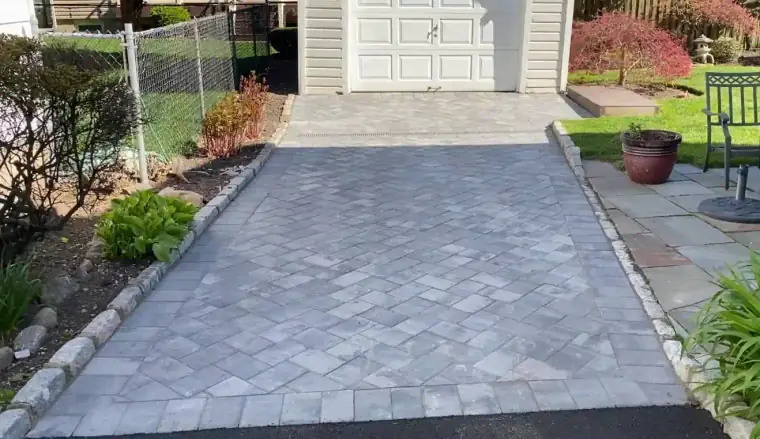
Asphalt, concrete, and paver driveways across Northern Virginia and DC. Base prep done right, every layer laid the way it should be.
Asphalt Driveways
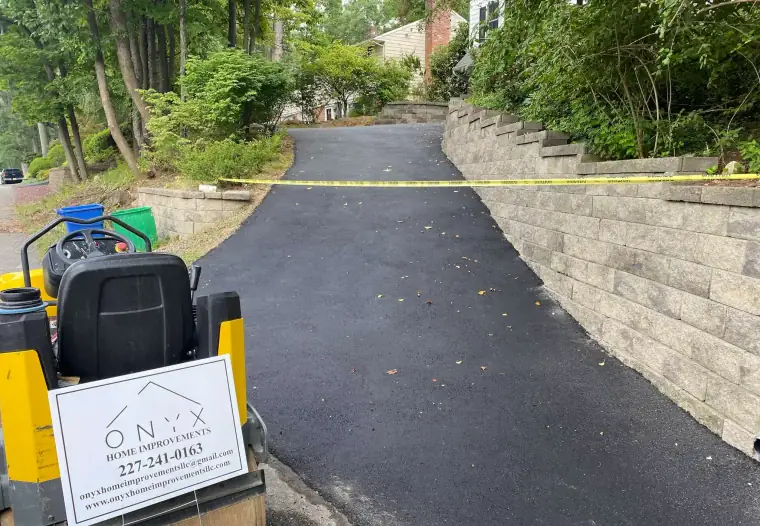
New asphalt driveways and full replacements. Torn out to depth, rebuilt on a compacted base, laid in lifts and rolled hot.
Paver Driveways
Interlocking paver driveways with borders, banding, and circular inlays. Set on a driveway-depth base, and repairable unit by unit.
Service area
Estimates are free everywhere on this list. If you are just outside it, call and ask — we often can.