
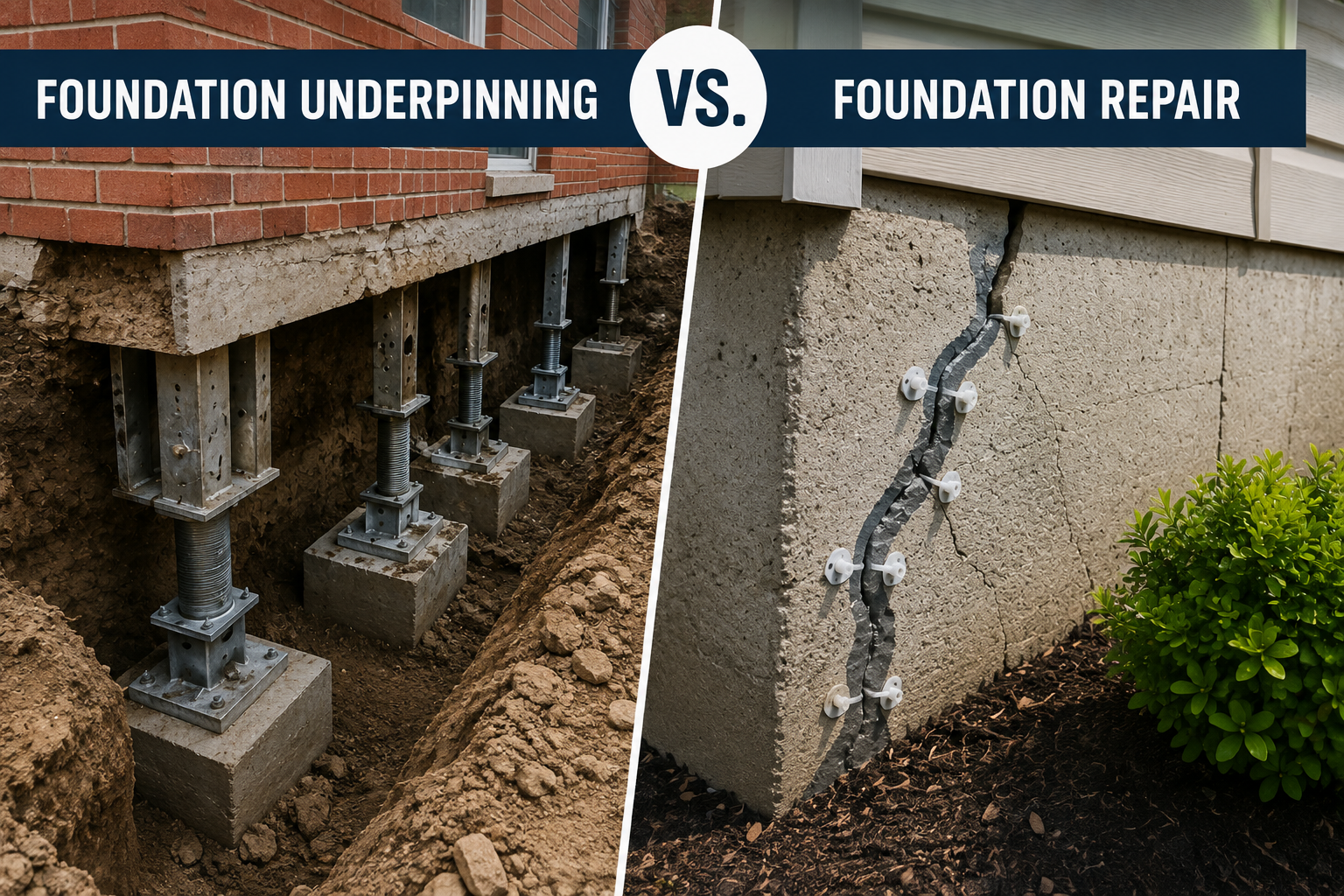
Foundation underpinning is a specialized way to strengthen or support an existing foundation when the current structure can no longer safely carry its load. It is different from a standard foundation repair, which may address cracks, water damage, or other localized problems. For homeowners planning home remodeling, knowing the difference can help you understand what type of work your property may need.
Key Takeaways
Foundation problems can look similar at first, but the right solution depends on the cause, severity, and condition of the structure. Some issues need a simple repair, while others may require deeper structural work.
Foundation repair addresses specific damage or defects.
Underpinning strengthens or extends the support beneath an existing structure.
Basement work may require underpinning when the foundation must be lowered.
Soil movement can play a major role in foundation problems.
A structural professional should assess serious movement before work begins.
Early action can help prevent a small issue from becoming a larger one.
What Does Foundation Underpinning Mean?
Underpinning involves strengthening or extending the support beneath an existing building. The goal is to improve the foundation’s ability to carry loads or transfer those loads to stronger soil. This can be done for several reasons, such as settlement, changes in soil conditions, added loads, or changes to a basement.
The work is more involved than fixing a visible crack. It can require careful excavation, temporary support, engineering plans, and a specific work sequence. Because the existing structure depends on the foundation, each stage must be planned with care.
Common reasons for underpinning include:
The foundation has settled because of weak or changing soil.
A building will carry additional loads after an alteration.
A basement needs to be made deeper.
The existing foundation does not provide enough support.
Nearby construction has affected the soil or foundation.
A structural change requires a stronger load path.
The Ontario government describes underpinning as a process used to support or strengthen an existing foundation, including by reinforcing the foundation, improving soil support, or extending the foundation to spread loads over a larger area.
How Foundation Repair Differs
Foundation repair is a broader term that covers work used to correct damage or defects in a foundation. The repair may involve masonry, cracks, moisture problems, damaged sections, or other issues that do not require the entire foundation to be strengthened or extended.
For example, a small crack caused by normal movement may not require major structural work. A damaged block wall may need sections rebuilt. Water entering through a foundation wall may require sealing and drainage improvements rather than underpinning.
Common repair situations include:
Cracks in concrete or masonry.
Damaged or loose foundation blocks.
Deteriorated mortar joints.
Localized wall damage.
Water entering through foundation walls.
Surface deterioration or spalling.
Problems caused by poor drainage.
You can explore foundation repair services to see how different foundation problems can be assessed and addressed.
When Is More Than a Simple Repair Needed?
The biggest question is not how large a crack looks. The important issue is why the foundation is moving or failing. A professional assessment can help determine whether the problem is limited to one area or points to a deeper structural concern.
Some signs deserve closer attention, especially when several appear at the same time:
Cracks that continue to grow.
Doors or windows that suddenly become difficult to open.
Floors that slope or feel uneven.
Walls that appear to bow or move.
Repeated cracking after previous repairs.
Gaps between walls, ceilings, or floors.
Visible settlement around part of the home.
A repair may be enough when the underlying structure remains stable. More extensive structural repair may be considered when the foundation has lost support or when movement continues despite earlier work.
Why Soil Conditions Matter
Soil supports the foundation, so changes below the house can affect the entire structure. Different soils respond differently to moisture, loading, compaction, and seasonal changes. Poor drainage can also change the condition of soil around a foundation.
This is one reason two homes with similar-looking cracks may need different solutions. The visible damage is only part of the problem. The condition below and around the foundation also matters.
Important factors can include:
Soil type and bearing capacity.
Drainage around the home.
Changes in moisture levels.
Previous excavation or construction.
Settlement or soil consolidation.
The weight carried by the foundation.
The age and construction of the existing foundation.
Before major work begins, these conditions should be reviewed rather than treating the visible crack as the entire problem.
When Basement Work Can Involve Underpinning
Basement underpinning is often discussed when homeowners want to increase basement height or create more usable space below an existing home. Lowering a basement floor can change how loads are transferred through the foundation, so the existing support must be considered carefully.
Underpinning may be part of a plan when the foundation needs to be extended downward before the basement floor can safely be lowered. The work is not simply a matter of removing soil and pouring a deeper floor.
A basement project may require attention to:
Existing foundation depth.
Soil conditions below the current footing.
Structural loads from the home.
New basement floor elevation.
Water management.
Temporary structural support.
Local permit and engineering requirements.
For this reason, basement changes should be planned as structural work rather than treated as a simple remodeling task.
Signs That a Home May Need Structural Attention
Some foundation problems are easy to spot, while others develop slowly. Homeowners may first notice cosmetic changes before realizing that movement is occurring below the surface.
Look for patterns rather than relying on one sign. A single small crack does not automatically mean the foundation is failing. However, several signs appearing together can justify a professional inspection.
Watch for:
Stair-step cracks in masonry.
Horizontal cracks in foundation walls.
Cracks that become wider over time.
A wall that appears to bow inward.
Uneven floors.
Water entering through new cracks.
Repeated repairs that do not solve the problem.
Noticeable settlement on one side of the home.
If these conditions are present, avoid covering the damage before its cause is understood. A fresh coat of mortar or sealant may hide the symptom without correcting the source.
What Happens During an Underpinning Project?
Because underpinning affects an existing structure, the process needs careful planning. The exact method depends on the foundation type, soil, building loads, access, and reason for the work.
A typical project may involve several stages:
Inspection and assessment
The existing foundation, visible damage, soil conditions, and surrounding property are reviewed.Structural planning
The required support method and work sequence are determined based on the building and site conditions.Temporary support
Where needed, temporary measures help maintain stability while work is carried out.Controlled excavation
Soil is removed in planned sections rather than taking away support from the entire foundation at once.New or improved support
The selected system strengthens, extends, or redirects the foundation load.Inspection and completion
The completed work is checked before the area is restored.
The sequence matters because removing soil beside an existing foundation can create serious stability risks if the work is not properly planned. Ontario safety guidance also stresses engineered procedures and careful sequencing for underpinning work.
How Cost Can Differ Between the Two
The cost of foundation work varies widely because every property has different conditions. A localized repair may involve a small section of masonry, while underpinning can require excavation, temporary support, engineering, additional materials, and more labor.
The main cost factors can include:
Size and location of the affected area.
Foundation construction and materials.
Soil conditions.
Access to the work area.
Amount of excavation required.
Drainage or water problems.
Structural engineering needs.
Permits and local requirements.
Whether the basement or surrounding property must be restored.
This is why a visual estimate based only on the size of a crack can be misleading. The cause of the movement usually has a greater effect on the scope of work than the crack itself.
How Homeowners Can Prepare for an Assessment
Before a contractor or structural professional visits, homeowners can collect useful information about the problem. Simple observations can help explain how the issue has changed over time.
Make a note of:
When you first noticed the problem.
Whether cracks have changed in size.
Where water appears after rain.
Whether doors or windows have changed.
Whether floors feel uneven.
Whether previous repairs were completed.
Any recent excavation near the home.
Any major remodeling or additions.
Photos taken at different times can also help show whether a crack or wall condition is changing.
This information does not replace a professional inspection, but it can make the assessment more useful and help identify patterns that may otherwise be missed.
Why Drainage Should Not Be Ignored
Water is a common factor in foundation problems. Poor grading, blocked drainage, leaking gutters, or water collecting beside the home can keep soil wet and place added pressure on foundation walls.
Fixing the foundation without addressing a related water problem may leave the property exposed to future damage. Drainage should therefore be considered whenever there are signs of repeated moisture or movement.
Homeowners should check:
Whether downspouts discharge away from the foundation.
Whether the ground slopes away from the house.
Whether water collects beside foundation walls.
Whether basement walls show moisture stains.
Whether nearby paving directs water toward the house.
Whether existing drains are blocked or damaged.
A drainage correction may be a smaller and less disruptive part of the solution, but it can play an important role in protecting completed structural work.
Foundation Work During Home Remodeling
Major home remodeling can change the loads, layout, or use of a building. Removing walls, adding space, changing basement levels, or building an addition can all affect how loads move through the structure.
This does not mean every remodeling project needs underpinning. Instead, structural conditions should be considered before work begins.
For example:
Removing a load-bearing wall may require a new support system.
Adding another level can increase foundation loads.
Lowering a basement can affect existing footings.
An addition may create new loads beside the current foundation.
Excavation near the house can affect surrounding soil.
For homeowners considering home remodeling services, early planning can help avoid costly changes after construction has already started.
Choosing the Right Approach for Your Property
There is no single foundation solution that works for every house. The correct approach depends on the condition of the existing foundation, the cause of movement, the soil, and the work the homeowner wants to complete.
A useful starting point is to separate the problem into three questions:
Is the damage localized or widespread?
Is the foundation stable or continuing to move?
Does the planned project change the loads or foundation depth?
If the foundation is generally stable and the problem is localized, a repair may be suitable. If the structure needs additional support or the foundation must be extended, underpinning may be considered.
Homeowners in Northern Virginia can also review masonry and home improvement services when planning related structural or exterior work.
What Homeowners Should Not Do
Foundation problems can be stressful, but rushing into a repair can create more problems. Work that changes structural support should not be treated like a simple cosmetic improvement.
Avoid:
Covering serious cracks before they are assessed.
Excavating beside a foundation without proper planning.
Assuming every crack needs underpinning.
Assuming every crack is only cosmetic.
Ignoring water that repeatedly reaches the foundation.
Choosing a repair based only on the lowest price.
Starting major structural work without checking local requirements.
A careful assessment helps match the work to the actual problem. It can also prevent unnecessary construction.
When Should You Contact a Professional?
A professional assessment is worth considering when foundation movement is visible, growing, or linked with other structural changes. The sooner the cause is understood, the easier it may be to plan the right solution.
Contact a qualified professional if you notice:
Fast-growing or wide cracks.
Horizontal foundation wall cracks.
Significant wall movement.
Uneven or sinking floors.
Repeated structural cracking.
Signs of foundation settlement.
Plans to lower a basement.
Plans for major additions or structural changes.
If the issue appears serious, do not wait for the damage to become obvious throughout the house. Early evaluation can provide a clearer path forward.
Final Thoughts
Foundation underpinning and foundation repair are not the same thing. Repair usually focuses on correcting a specific foundation problem, while underpinning is used when an existing foundation needs additional support, greater depth, or a different way to transfer loads.
The right choice depends on the cause of the problem, the condition of the existing structure, soil conditions, and the work planned for the property. A careful inspection should come before major structural work so the solution addresses the actual cause rather than only the visible damage.
If you are planning foundation work, basement changes, or related home improvements in Northern Virginia, contact Onyx Home Improvement LLC to discuss your property and request a free estimate.